
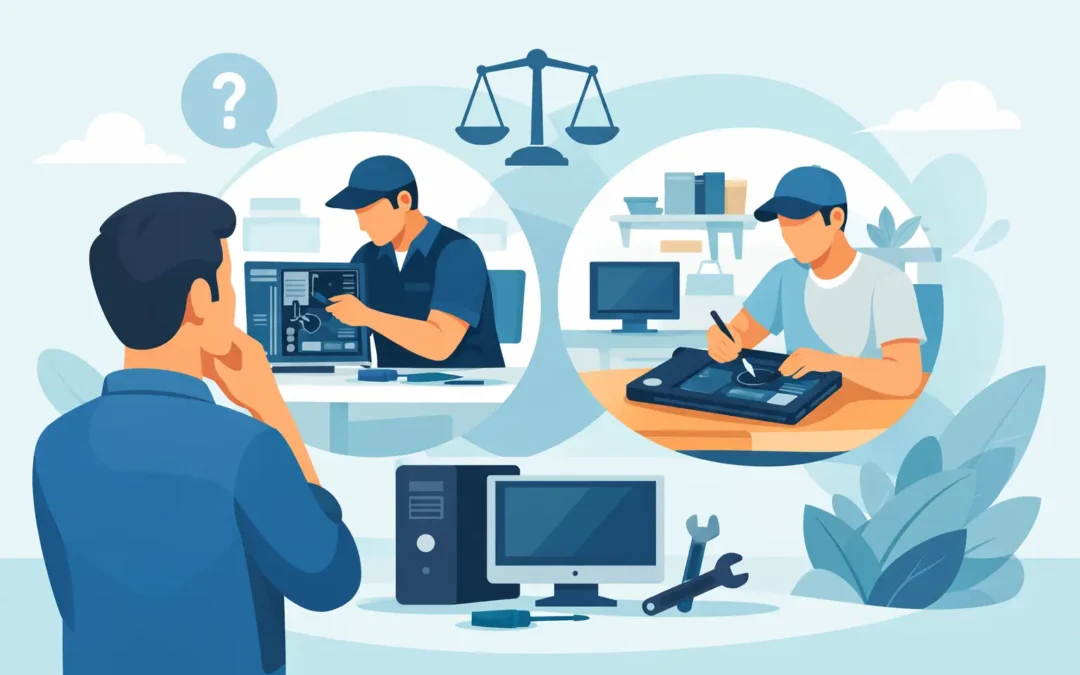
When your laptop stops charging the night before a deadline, or your desktop suddenly starts freezing in the middle of work, the wrong decision is often the fastest one. A pc repair shop should do more than take your device, hand you a claim ticket, and hope for the best. It should give you clear answers, realistic timelines, and confidence that your computer is being handled by people who know exactly what they are doing.
That matters more than most customers realize. A computer is rarely just a machine. It holds school projects, business files, photos, client records, and the day-to-day tools people rely on to stay productive. Choosing where to take it is not only about who can replace a part. It is about who can diagnose the real issue, explain it plainly, and repair it without wasting your time or money.
What a good pc repair shop actually does
A strong repair provider starts with diagnosis, not guessing. Many computer problems look similar on the surface. A laptop that will not power on could have a failed charger, a bad battery, a damaged charging circuit, or a deeper board-level issue. A slow system might need storage replacement, malware cleanup, memory upgrades, or simply a proper software tune-up. If a shop jumps straight to a fix without proper testing, that usually leads to repeat visits, extra cost, and frustration.
A reliable pc repair shop should be able to assess both hardware and software issues across different systems. That includes Windows PCs, custom desktops, business laptops, and in many cases Apple devices as well. If a company positions itself as a specialist, it should be able to tell you where the problem starts, what repair options make sense, and whether the repair is worth doing compared with replacement.
That last point is important. Honest service does not mean recommending repair every time. Sometimes the smarter choice is to protect your data, avoid unnecessary expense, and move on from aging hardware. Good technicians know the difference.
Signs you are dealing with a trustworthy pc repair shop
The first sign is simple communication. You should be able to explain the issue and get a clear explanation of next steps. Not a rushed answer. Not vague promises. Just a straightforward process for intake, diagnostics, approval, repair, and pickup.
Transparent quoting is another strong indicator. Some problems can be priced quickly, while others need inspection first. That is normal. What matters is whether the shop explains that clearly. A trustworthy provider tells you when a device needs diagnostics before a final quote can be given, and it gets your approval before major work begins.
Turnaround matters too, but honesty matters more. Fast repair sounds great until a shop overpromises and underdelivers. The better approach is realistic timing based on parts availability, repair complexity, and current workload. If a technician tells you a repair may take longer because proper testing is required, that is usually a good sign, not a bad one.
Professional handling should also be visible in the process. Devices should be checked in properly, concerns should be documented, and customers should know how they will be contacted. That may sound basic, but organized service is often the difference between a smooth repair and a stressful one.
Common repairs and where experience matters
Some repairs are routine, but routine does not mean careless. Screen replacement, battery service, charging issues, keyboard faults, overheating, storage upgrades, and data-related problems all require attention to detail. Even a basic part swap can go wrong if the technician misses hidden damage or uses poor-quality components.
Experience matters most when symptoms overlap. For example, a laptop that randomly shuts down may have a thermal issue, a power problem, or motherboard damage. A MacBook with charging trouble may need more than a new adapter. A desktop that will not boot may have a failing drive, memory errors, or a power supply issue. Shops with broad repair experience tend to diagnose these situations more accurately because they have seen the patterns before.
This is where a specialist stands apart from a general electronics counter. A true repair-focused business understands how different models fail, how to test properly, and how to avoid unnecessary part replacement. That protects both your device and your budget.
Pricing, timelines, and the truth customers need
Customers usually want two answers first: how much and how long. Those are fair questions, but the honest answer is sometimes it depends.
Simple repairs with known symptoms can often be estimated quickly. More complex faults need diagnosis before cost can be confirmed. That is not a red flag. It is a sign the shop is trying to avoid guessing. The same goes for turnaround. If a repair depends on special-order parts or deeper testing, an exact completion time may not be possible on day one.
What you should expect is transparency. You should know whether there is a diagnostic fee, whether that fee applies toward repair, what happens if you decline service, and when the shop expects to update you. Clear expectations reduce stress, especially when the computer is essential for school, work, or business operations.
For business users, this is even more important. Downtime affects more than one device. It affects communication, billing, file access, and customer service. A dependable repair partner understands that urgency and responds accordingly, even when the correct answer is not the fastest one.
Why local support still matters
Mail-in repair has its place, but local service offers advantages that are hard to replace. You can speak directly with a technician or service team, explain the issue in context, and get practical guidance based on how you actually use the device. That leads to better diagnosis and fewer misunderstandings.
Local repair also makes follow-up easier. If your issue changes, if you need help with an accessory, or if you want to discuss upgrade options instead of repair, you are dealing with a real team you can reach. For many customers, that peace of mind matters just as much as the repair itself.
In a market like Jamaica, where dependable support can make a major difference for students, professionals, and small businesses, working with an established specialist is often the safer choice. Stealth PC Technology has built its reputation around that kind of practical, customer-first service across both Mac and Windows systems.
Accessories and add-ons are part of the repair picture
A repair is not always the whole solution. Sometimes the issue starts with a worn charger, an unreliable adapter, the wrong cable, or failing power accessories that create symptoms resembling device failure. That is one reason a well-run repair business often carries tested accessories and power products alongside service.
This can save time and reduce guesswork. If your laptop is not charging, confirming the condition of the charger and power path early can prevent unnecessary repair work. If your desktop setup is unstable because of a bad cable or unsupported adapter, replacing the right accessory may solve the problem immediately.
The key is whether those products are recommended based on need, not pressure. Customers should feel advised, not pushed.
How to know when to repair and when to replace
Not every computer should be repaired. Age, condition, value, and intended use all matter. A fairly recent device with a bad battery, broken screen, or storage failure is often worth fixing. An older machine with multiple issues, outdated performance, and limited part availability may not be.
A good shop will walk you through that decision honestly. If a repair will restore several more years of useful life, that is worth knowing. If the cost is getting too close to replacement value, that should be said clearly too. Customers do not need sales pressure. They need informed guidance.
That is especially true for people balancing budgets. Students, remote workers, and small business owners often need the most practical answer, not the most expensive one.
The standard customers should expect
A pc repair shop earns trust in small ways before it earns it in technical ones. Clear intake. Careful diagnosis. Honest quotes. Realistic timing. Respect for your data, your budget, and your time.
Those basics matter because repair is a service business first. Technical skill is essential, but so is the ability to explain problems calmly, answer questions clearly, and treat each device like it matters. Because to the customer, it does.
If your computer is acting up, do not settle for a quick guess or a vague promise. Choose a shop that gives you a straight answer, does careful work, and helps you make the right decision for your device, even when that decision is not the easiest one.